The Physcology of Money-Morgan Housel
If I could only ever read one book. It would be this.
BOOK REVIEWPERSONAL FINANCEMUST READ!
Cathal Walsh
7/16/20265 min read
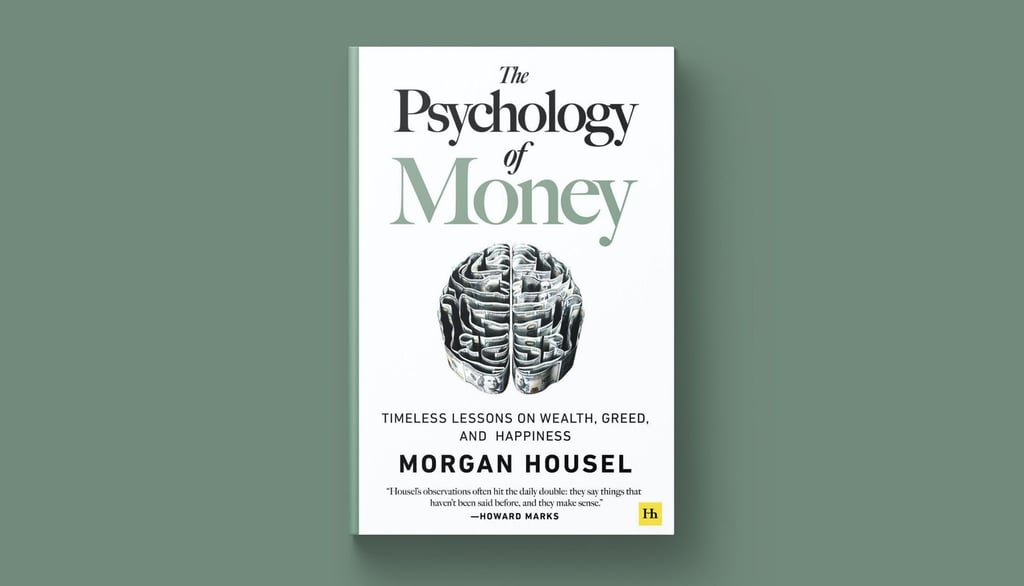
The Book in 3 Sentences
“The Psychology of Money” argues that financial success is less about knowledge and more about behaviour—how you think and act with money matters more than what you know.
People’s decisions are shaped by personal experiences, emotions, and biases, meaning rational choices often take a back seat to fear, greed, and social influence.
Ultimately, building wealth is less about chasing high returns and more about patience, humility, and consistency over time.
❗️Key Points/Takeaways❗️
No one’s crazy
What one person does with money might seem completely absurd to another, but still everyone has justification
“People from different generations, raised by different parents who earned different incomes and held different values, in different parts of the world, born into different economies, experiencing different job markets with different incentives and different different degrees of luck, learn very different lessons.
The person who grew up in poverty thinks about risk and reward in ways the child of a wealthy banker cannot fathom if he tried.
We all think we know how the world works. But we’ve all only experienced a tiny sliver of it.
Luck and risk
Nothing is as good or as bad as it seems
Everything in life can is some how related to luck and risk
Bill Gates knows and knew a lot about computers at the right time and was able to make a business out of it. But he had a one in a million+ advantage that no one else had. His school had a computer and he learnt everything to do with it, however his close friend died in a rock climbing accident which is again one in a million+ and was likely to be as successful as Bill Gates. Luck and risk in action.
Focus less on specific individuals and case studies and more on broad trends and patterns.
Never enough
When rich people do crazy things
Know what’s enough
The hardest financial skill is getting the goalpost to stop moving
Stop comparing yourself to others
There are many things never worth risking, no matter the potential gains
Reputation
Freedom and independence
Family and friends
Happiness
Are all invaluable
Confounding Compounding
$81.5 billion of Warren Buffet’s $84.5 billion net worth came after his 65th birthday
As long as you have stable returns and invest early you are guaranteed success
Compounding interest is almost as mind blowing as the size of our universe
If a 15 year old invested €250 every month into a stable ETF that grew at 10% every year, by the time he retires he would have € 4,367,440.18 and would have only put in €150,250. That’s almost 30 times what he invested.
Getting Wealthy vs. Staying Wealthy
“Good investing is not necessarily about making good decisions. It’s about not screwing up.
Getting money and keeping money are two different skills
Growing wealthy is like “surviving” over a long period of time
Be financially unbreakable, because if you’re able to stick around the long enough compounding will work it’s wonders.
Plan for the plan to not go according to plan.
Optimistic about the future, but paranoid about what will prevent you from getting there.
Tails, You Win
You can be wrong half the time and still win
Every large and substantial win is just the result of a tail event
Tail events are extremely unlikely events that are not common, e.g making 500 movies and 1 of them becoming extremely famous
Freedom
Controlling your time is the highest dividend money pays
Freedom of time is the highest form of wealth
People like to feel like they’re in control
Freedom of time is the no.1 indicator of happiness, by far
Savings help you achieve control of your time
Man in the Car Paradox/ Wealth is What You Don’t See
No one is impressed with your possessions as much as you are.
If you see someone in a nice car you don’t think “wow, the guy driving that car is cool”. Instead you think, “Wow, if I had that car people would think I’m cool”
Save Money
Building wealth has little to do with your income and lots to do with your saving rates
It’s about how much you spend, not how much you make, learn to be happy with less
Past a certain level of income, what you need is just what sits below your income
Savings can be created by spending less. You can spend less by desiring less. And you will desire less if you care less about what others think of you.
Intelligence is an extremely competitive market, flexibility isn’t
Reasonable > Rational
Aiming to be mostly reasonable works better than trying to be coldly rational.
Something can be technically/mathematically true, but it may make no sense when put into practice
Surprise!
History is the study of change, ironically used as a map of the future.
Small events can have huge consequences
The world is completely unpredictable
The past doesn’t represent the future and the future doesn’t represent the past
Events can be far, far worse or better than ever before and we wouldn’t imagine the event being t that scale until it has already happened
Room For Error
The most important part of every plan is planning on your plan not going according to plan.
Nothing is certain in life, it is full of unknowns
We don’t need to view the world as black or white. We should focus on the grey areas - this is the range of possible outcomes that are acceptable
Always leave a margin of error
Presume that the historic ROI will be 1/3 lower than it is, so therefore is it is lower you have planned for it, and if it stays the same or increases you will be happy
If something is heavily in your favour, but the cost of it going against you is devastating, don’t take the risk
No risk is ever worth talking if you can’t survive losing the bet
Never rely on a single point of failure, everything that can brake, will brake, so you have to rely on multiple things and have backups
How this relates to money: don’t rely on one income stream and save even when you don’t know what you’re saving for
You & Me
Beware taking financial cues from someone playing a different game than you are.
Every investor has different goals and time horizons
Someone flipping a house might buy a 2 bedroom house for €700,000, but that’s not feasible for someone planning to grow their family in the house for 20 years
Don’t invest or take advice from someone who has different goals than you
All Together Now
Summary of sorts
It’s never as good or as bad as it looks
Always ask “does this help me sleep at night?“
Broaden your time horizon
Become ok with lots of things going wrong
Use money to gain control over your time
Be nicer and less flashy
Nothing worthwhile is free - define the cost of success and be ready to pay it
Worship room for error
Top 3 Quotes
Savings can be created by spending less. You can spend less by desiring less. And you will desire less if you care less about what others think of you.
”Doing well with money has little to do with how smart you are and a lot to do with how you behave”
”Wealth is what you don’t see”
”The ability to do what you want, when you want, with who you want, for as long as you want, is priceless.”
Who Should Read It?
Everyone, absolutely everyone